
China EV Charging Piles 2026: Six Industry Trends(Sep 18)
Six Major Trends and Market Landscape of China's Charging Pile Industry in 2026
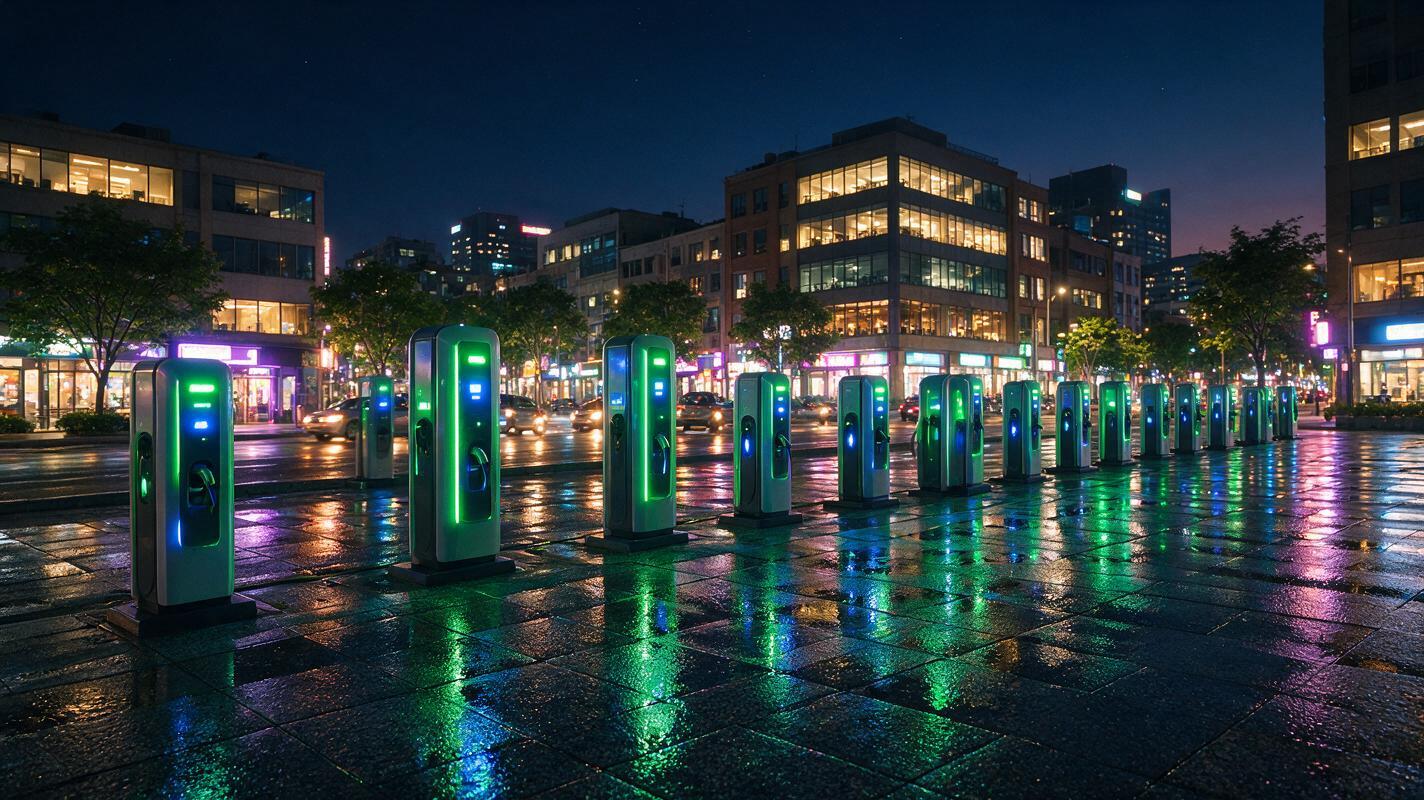
According to the latest data released by the China Electric Vehicle Charging Infrastructure Promotion Alliance (EVCIPA) in June 2026, the national public charging pile inventory has exceeded 4.8 million units, up approximately 18% from the end of 2025, while cumulative private charging pile installations have surpassed 12 million units. The National Energy Administration has explicitly proposed in its "2026 Energy Work Guidance" to continue promoting the extension of charging infrastructure to county and township levels. Driven by both policy and market demand, China's charging pile industry is entering a critical stage of transitioning from scale expansion to quality upgrading.
1. Market Scale Continues to Expand, Structural Contradictions Emerge
In the first half of 2026, China's new energy vehicle inventory exceeded 37 million, with a vehicle-to-pile ratio of approximately 2.4:1, still short of the national target of 2:1. While a supply gap remains in total terms, structurally, DC fast charging accounts for less than 35% of public charging piles, while user demand for fast charging exceeds 60%, highlighting a prominent supply-demand mismatch. Meanwhile, the number of charging pile manufacturing enterprises has exceeded 3,000, with low industry concentration. The top ten manufacturers' combined market share is less than 45%, with numerous small and medium vendors concentrated in the low-power AC pile segment, causing severe product homogenization.
2. High-Power Fast Charging Becomes the Main Investment Track
In 2026, high-power fast charging has become the core direction of charging infrastructure investment. In charging stations deployed by State Grid and China Southern Power Grid along highway service areas and national/provincial trunk roads, the proportion of 120 kW and above fast charging piles has been raised to over 75%. Liquid-cooled supercharging technology has transitioned from pilot to scaled application, with 400 kW to 480 kW liquid-cooled supercharging equipment entering commercial operation in multiple cities. This demands higher capabilities from equipment manufacturers: self-developed core power modules, continuous iteration of thermal dissipation technology, and intelligent flexible power dispatching.
3. Full-Scenario Coverage Becomes the Core Selection Standard
A significant change in the 2026 charging pile market is that single-category vendors' market space is narrowing. The diversification of charging scenarios, from residential communities to commercial parks, from public charging stations to heavy truck logistics energy replenishment, from two-wheeler charging to shore power for vessels, requires equipment suppliers to possess cross-scenario, cross-power-range product delivery capabilities. Procurement parties increasingly prefer multi-category suppliers that can cover AC piles, DC piles, high-power fast charging, charging stack systems, two-wheeler charging equipment, and special vehicle charging equipment, to reduce management complexity and system compatibility risks from multi-vendor coordination.
4. National Grid Promotes 100% Charging Infrastructure in New Residential Areas
On September 16, 2026, State Grid Corporation released measures to build a modernized electricity business environment. In the green travel domain, the measures propose promoting 100% pre-installation or reservation of private charging facilities for fixed parking spaces in new residential communities, and establishing a "green channel" to support unified construction and service of community public charging facilities.
5. Zhejiang Province Charging Infrastructure Exceeds 3 Million Units
As of the end of August 2026, Zhejiang Province's total charging infrastructure reached 3.0807 million units, including 276,400 public charging piles and 2.8043 million private charging piles, achieving a vehicle-to-pile ratio of approximately 1.56:1. Among public charging piles, 92,200 are deployed in rural areas, accounting for about one-third, with increasingly balanced urban-rural coverage. The province has essentially formed a "5-minute urban, 30-minute rural" charging circle, achieving 100% coverage of public charging piles in townships with demand.
6. Green Electricity and Innovation in Charging Models
Zhejiang has pioneered the "new energy vehicles charged with new energy electricity" model, aggregating scattered charging resources to participate in green electricity trading. Hangzhou and Huzhou have achieved full green electricity supply coverage for State Grid charging piles. The province's charging piles have cumulatively consumed over 52 million kWh of green electricity. Additionally, as a major economic and logistics province, Zhejiang is actively promoting the integrated development of "logistics network + energy network," with over 456 heavy truck charging and battery swapping stations reported as of August.
This platform focuses on the import and export of Chinese automotive equipment, gathering hundreds of certified Chinese automotive suppliers and connecting with global buyers. The platform achieves full transaction transparency, expands diverse cooperation opportunities, and helps both domestic and foreign parties build deep and stable cooperation bonds. Whether you are looking for vehicle manufacturers, purchasing automotive parts, or need customized procurement solutions, CNAUTO is your trusted first choice for cooperation.
-
China EV Charging Piles 2026: Six Industry Trends(Sep 18)6296
-
XCMG: Electric Heavy Truck Hits 2,198km in 24hr Test(Sep 18)5686
-
CIMC: NA Semi-Trailer Orders Recover, Capacity Upgraded(Sep 18)7161
-
"Green Iron Ox": Methanol Autonomous Tractor(Sep 17)9526
-
NEV 15th Five-Year Plan: 70% Sales Target by 2030(Sep 17)9865




