
Quiet Tires Market Growth and Technology
When a vehicle traverses a rough road, the noise generated by the friction between the tires and the ground acts like an invisible pressure, seeping into every corner of the cabin. In the high-end automotive market, this noise is being redefined by a technology—quiet tires, once an exclusive feature of luxury cars, are gradually evolving into a crucial element in assessing driving quality.
According to data released by the European Tyre & Rubber Manufacturers Association and domestic industry research institutions, the global quiet tire market was worth approximately $4.8 billion in 2025 and is projected to exceed $5.6 billion in 2026, maintaining a compound annual growth rate of around 12.5%.
The main driver of this growth is the rapid popularization of new energy vehicles: electric vehicles, lacking the shielding of engine noise, place higher demands on tire noise control, which is a key factor accelerating the penetration of quiet tires.
The technological race between international brands like Michelin and Bridgestone and Chinese brands is reshaping the value landscape of the tire industry. In the international market, Michelin Primacy 5 features Acoustic sound-absorbing cotton technology, achieving noise reduction at various speeds and suitable for models such as the Tesla Model 3 and Audi A6L.
Bridgestone, relying on its B-SILENT sound-absorbing cotton technology, covers its high-end product line. Its ENLITEN® technology, through molecular-level material optimization, reduces rolling resistance by 20% and improves wear resistance by 30%, making it suitable for many new energy vehicle models.
Domestic brands are rapidly rising in the aftermarket. Brands such as Thor, Chaoyang, and Dongfeng Shengli have gained market attention due to their high cost-performance ratio and comprehensive specification coverage.
Among them, Thor's Silent Pro tire once ranked among the top sellers in the sound-absorbing cotton tire category on Tuhu Auto Service, with several specifications selling out at times. Dongfeng Shengli tires competed with international brands in industry evaluations, winning two honors: "Top Ten Tires of the Year" and "Comfort Tire of the Year."

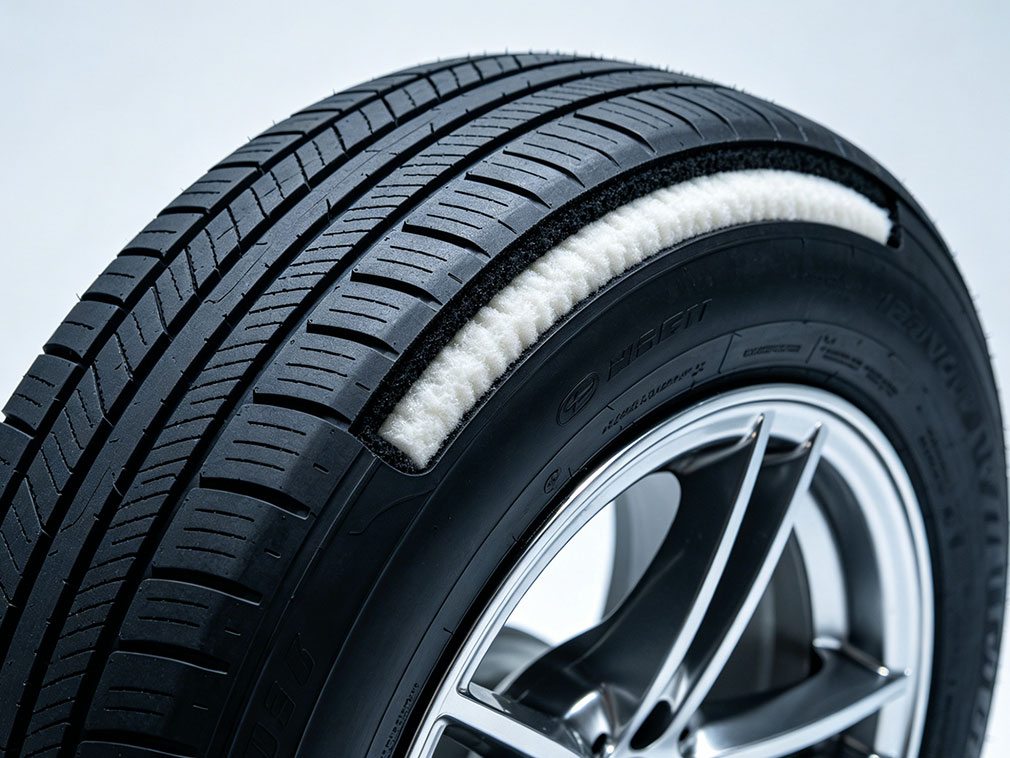
Sound-absorbing cotton tires create an "acoustic trap" by bonding polyurethane or porous fiber sound-absorbing materials to the inner wall of the tire cavity, reducing cavity resonance noise by 3 to 4 decibels.
This number may seem small, but the actual experience is like stepping from a busy street into a quiet library—at 40km/h on city roads, ordinary tire noise is about 65dB, while sound-absorbing cotton tires can reduce it to 62dB, allowing navigation volume to be lowered by two levels; at 120km/h on highways, ordinary tire noise is about 72dB, while sound-absorbing cotton tires can reduce it to 68dB, eliminating the need to raise the volume for conversations in the back seat.
This physical noise reduction solution directly addresses the essence of tire noise: when tires roll, the air pumping effect created by the tread pattern pressing against the road surface generates high-frequency noise, while the cavity resonance caused by tire vibration produces low-frequency booming. The porous structure of the sound-absorbing cotton allows vibrating air to generate friction as it passes through the pore walls, attenuating the vibration and weakening both high-frequency and low-frequency noise.
Unlike traditional tires that rely on passive noise reduction methods such as softening the tread rubber and optimizing tread pattern design, the active sound absorption characteristics of sound-absorbing cotton are more targeted and do not sacrifice tire wear resistance or grip. Currently, the mainstream sound-absorbing foam is mostly 5 to 8 millimeters thick, made of polyurethane foam. This material is widely used in industrial fields such as aircraft seat filling, offering both sound insulation and vibration damping properties.
Some products have also undergone high and low temperature testing from -20℃ to 80℃ to ensure a firm fit even in extreme climates. More intuitively, the sound-absorbing foam is directly attached to the tire cavity, making it visible and tangible to consumers, and easier to explain in stores. Compared to understanding complex tread designs and rubber compounds, the noise reduction effect of sound-absorbing foam is more easily perceived, accelerating market acceptance and adoption.
Currently, the market demand for sound-absorbing foam tires has expanded from high-end luxury cars to mid-range and new energy vehicles. With over 350 million vehicles in China and a new energy vehicle penetration rate exceeding 40%, both the genuine need for quietness among new energy vehicle owners and the expectation of upgraded driving experience among gasoline vehicle owners provide a vast market space for sound-absorbing foam tires.
There are also areas in the industry that require continuous optimization. For example, some car owners have reported that the sound-dampening material is easily damaged during tire repair, resulting in slightly higher repair costs compared to regular tires. Some users also believe that the sound-dampening effect varies depending on the vehicle model and road conditions.
In response to this feedback, domestic and international brands are continuously increasing their R&D investment to optimize the sound-dampening material bonding process and material performance, while also expanding specification coverage. This allows tires with sound-dampening material to meet both high-end demands and be compatible with more common vehicle models, promoting this technology as an important feature for improving driving comfort and continuously extending the value proposition of the tire industry.
-
National Day Highway Charging Hits Record: +60.4% YoY(Oct 8)8275
-
New Energy Vehicle Exports Accelerate: 3.435 Million Units in First 8 Months, Up 120% Year-on-Year(Oct 8)8897
-
Chinese Tire Exports: Volume Up But Revenue Down Nearly RMB 900 Per Ton(Oct 8)5414
-
CNH Industrial: Smart Farming, NE and Local Tech(Sep 30)5597
-
CNHTC Drives Surging NE Heavy Truck Exports(Sep 30)8513




