Smart Agricultural Machinery Gains Momentum, Bringing New Vitality to the Fields(Nov 11)
November 11, 2026
CNAUTO
8628
Guide
Highlights at a glance
Smart agricultural machinery is driving a transformation in farming. Fully automated drones, intelligent robots, and Beidou-enabled tractors are enhancing precision farming, simplifying operations, and maximizing productivity. At the recent 2026 China International Agricultural Machinery Exhibition, innovative advancements were showcased, highlighting the shift from traditional mechanization toward smart technology. This pivot enables digital solutions to standardize farming techniques for increased work efficiency, environmental sustainability, and expanded arable land use, even in challenging terrain like hills. The future of agriculture lies in smarter, greener equipment harnessing AI and renewable energy to ensure food security and high-quality development.
Smart Agricultural Machinery Gains Momentum, Bringing New Vitality to the Fields
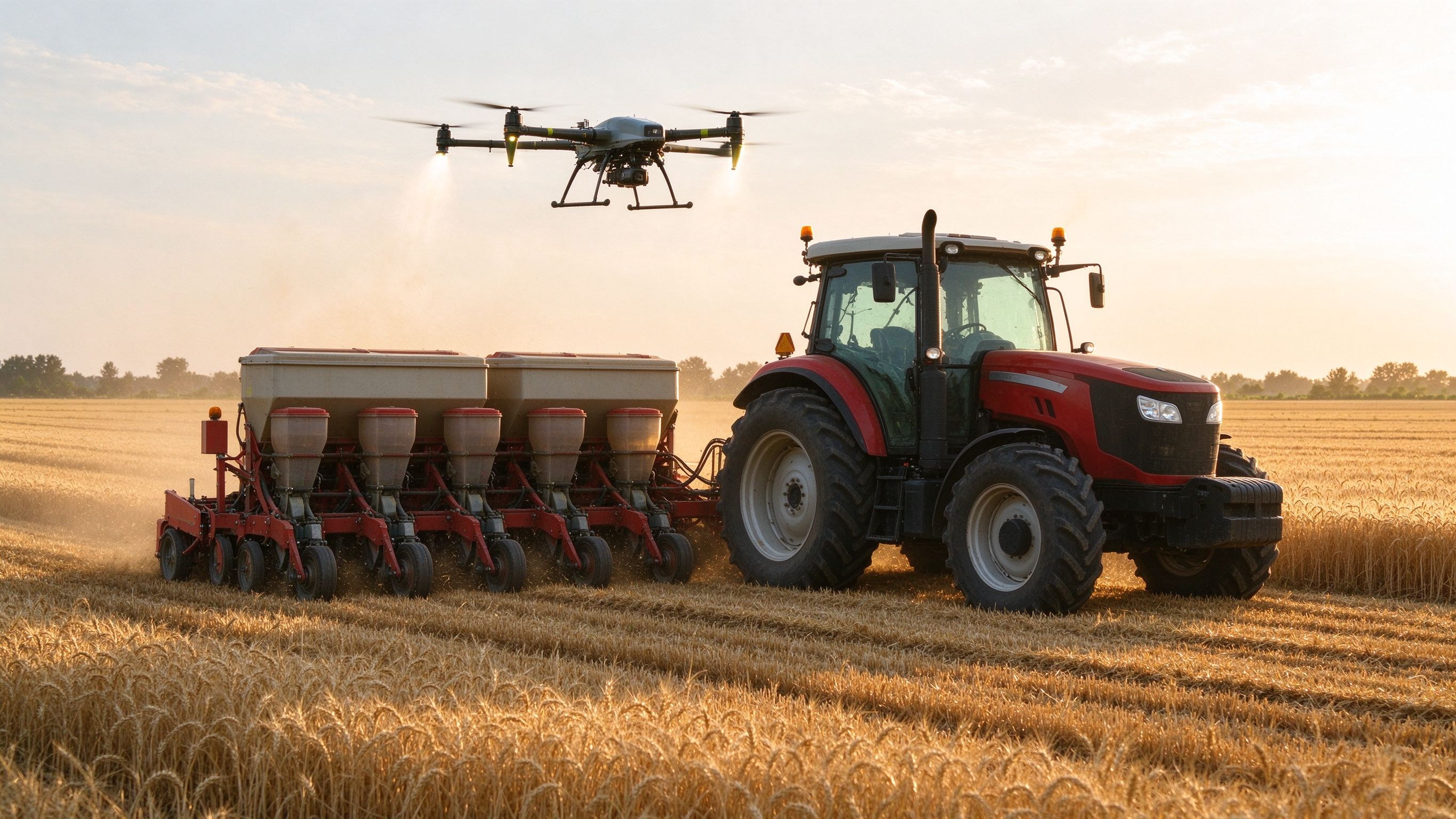
The bulk of the autumn harvest has been brought in, and winter wheat sowing is now under way. The field—the oldest of workshops—is undergoing a quiet, largely invisible transformation.
Plant-protection drones carry out fully automated operations; on-board operational agents have been fitted into tractor cabs; weeding robots use intelligent vision recognition to distinguish crops from weeds with precision. At the 2026 China International Agricultural Machinery Exhibition held recently in Tianjin, a number of Chinese machinery makers showed off their core strengths, with a lineup of new products brimming with digital technology. What is most telling is not the bustle on the exhibition stands, but the farming landscape these iron bulls are reshaping once they move out into the fields.
Consider the most visible changes. At the experimental demonstration base of Nongxiang Seed Industry in Guocang Town, Wenshang County, Shandong Province, the corn has been harvested, and the deep-ploughed, prepared land lies level and open. A high-horsepower tractor equipped with a Beidou navigation-assisted driving system tows a combined precision seed drill steadily forward, dropping every wheat seed precisely into the soil.
Fertilization, sowing and soil covering are completed in a single pass. Centimeter-level accuracy keeps the machine traveling straight and the seeds evenly spaced, leaving no blank patches along field edges. The base head, Yang Chuanfeng, squatted by the field edge, brushed aside the freshly sown soil, and remarked that machinery work is gradually relying less on the feel and experience of veteran hands; the oversowing and missed-seeding problems common under manual driving have been greatly improved.
Data from the Ministry of Agriculture and Rural Affairs provide the backdrop for this change. The national comprehensive mechanization rate for crop cultivation, planting and harvesting has reached 76.82%; the country has 19.9919 million tractors and 42.1627 million matching farm implements. In recent years, high-end smart agricultural machinery has been rolled out at an accelerating pace: a batch of advanced equipment has entered mass production, including 300-horsepower continuously variable transmission tractors, electric-drive high-speed precision seed drills, and grain combine harvesters with a 15 kg/s feeding capacity.
Behind the figures lies a shift in the underlying logic. Professor Qiu Tongwei of Nanjing Agricultural University noted that over the past decades, the main thrust of agricultural mechanization was to replace human and animal labor, using mechanical power to compensate for production limitations. As Beidou navigation and machine vision take hold, the core of smart machinery has turned to distilling and calibrating farming know-how, giving age-old cultivation precise and controllable digital operating standards.
For example, a weeding robot tells crops from weeds through algorithmic judgment; a smart water-fertilizer dispenser precisely balances nutrients based on real-time field data collected by sensors.
According to Qiu, when field experience that was once passed down orally and resisted standardization is loaded into algorithms, the stability and controllability of agricultural production rise markedly. This is not merely a matter of working faster; it is a generational leap in the way farming is organized.
This transition has remained confined neither to the contiguous plains where machinery conditions are favorable, nor to easier settings; it is extending into production scenarios where machinery once struggled to operate.
Hills and mountainous areas have long been the hard nut of machinery adoption. In the fields tucked among the hills in Butou Township, Xingguo County, Jiangxi Province, a field trial organized by Jiangxi Jianmo New Energy Technology Co., Ltd. is under way: unmanned machinery follows remote-control signals to plow and break up soil, while compact walk-behind micro-tillers turn nimbly and weave through the scattered, narrow small plots.
Liu Yanzhou, a farmer who came to observe, said the new equipment makes U-turns conveniently and turns flexibly, as easy to operate as riding an electric scooter; it can work plots no bigger than a palm, something traditional large machinery cannot do.
Steep slopes, narrow roads and fragmented plots once held back mechanization in mountain agriculture. Today, coordinated innovation across multiple regions is pushing a batch of lightweight, compact smart machinery from the laboratory to the fields, moving hill and mountain agriculture from no machinery available toward good machinery available, and extending the operating boundary of farm equipment to a wider range of arable land.
As machinery becomes smarter and more precise, the green transition is also accelerating. Precision operations themselves represent careful stewardship of farm inputs, water and soil, while electric and hydrogen power reduce the environmental impact of cultivation at the energy source. Green is no longer an extra label pasted on, but a direction along which smart machinery keeps upgrading.
Five minutes of refueling gives four hours of operating range. At the National Innovation Center of Agricultural Machinery Equipment in Luoyang, Henan, a silver-gray, streamlined 5G-plus hydrogen-fuel electric tractor stands out with its futuristic look. Li Yichen, a mechanical engineer at the center's General Machinery Research Institute, explained that the tractor uses a hydrogen fuel cell as its primary power source and a lithium battery as backup, with a hydrogen-to-electricity conversion efficiency above 55%, zero emissions throughout operation, and perception and unmanned driving enabled by 5G.
An asparagus production robot developed by the Nanjing Institute of Agricultural Mechanization, Ministry of Agriculture and Rural Affairs, links up key stages including harvesting, transport and sorting, and runs on pure electric drive. Researcher Xia Xianfei said the asparagus harvesting robot achieves an identification accuracy above 95%; its companion multi-legged transport robot adapts to varied terrain and can carry a load of up to 100 kilograms. The robots operate autonomously and use clean power, balancing production efficiency with environmental friendliness.
The 15th Five-Year Plan for Accelerating Agricultural and Rural Modernization explicitly calls for developing and deploying advanced, suitable farm equipment, and advancing the use of artificial intelligence and smart agriculture. Drones and agricultural robots have been written into the central No. 1 document for the first time. Top-level design charts the path for machinery to move toward smarter, greener solutions and wider arable land, giving frontline explorers a clear direction.
In the opening year of the 15th Five-Year Plan, policy, technology and industry are moving in the same direction. More and more smart machines are rolling across the fields, pushing farming toward greater precision, adaptability and low carbon. Technology adds a fresh, intelligent dimension to modern agriculture; while strengthening the foundation of food security, it also builds further momentum for high-quality development.
This platform focuses on the import and export of Chinese automotive equipment, gathering hundreds of certified Chinese automotive suppliers and connecting with global buyers. The platform achieves full transaction transparency, expands diverse cooperation opportunities, and helps both domestic and foreign parties build deep and stable cooperation bonds. Whether you are looking for vehicle manufacturers, purchasing automotive parts, or need customized procurement solutions, CNAUTO is your trusted first choice for cooperation.
Recommended for you
-
Smart Agricultural Machinery Gains Momentum, Bringing New Vitality to the Fields(Nov 11)8630
-
A New Round of Tire Price Hikes Grows Markedly Larger(Nov 11)7108
-
Used-Car Transactions Approach New-Car Levels; Residual Values of NEVs Recovering Fast(Nov 11)5516
-
Smart Agricultural Machinery Accelerates, Bringing New Vitality to the Fields(Nov 10)5783
-
Concentrated Overseas Rubber Arrivals in Early November Weigh on Prices(Nov 10)5313