
Tire Grip Performance Testing: Methods & Metric
Tire grip performance is a key factor in ensuring vehicle braking, steering, and handling stability, directly impacting driving safety and the driving experience. The main purpose of grip testing is to systematically verify whether the tire's overall structure, tread pattern design, and rubber compound formulation can meet the actual usage requirements under different road conditions, vehicle speeds, and loads, providing accurate data support for tire R&D optimization, performance calibration, and quality acceptance.
Currently, the industry-standard testing system is mainly divided into two modules: analytical testing and whole-vehicle road testing. These two modules complement each other, covering controllable laboratory conditions and real-world road scenarios.
Analytical testing is a controlled test conducted under laboratory conditions. It mainly relies on equipment such as road simulators, drum test benches, and dedicated test vehicles, which can eliminate external interference such as weather and road conditions, achieving precise control of test variables.
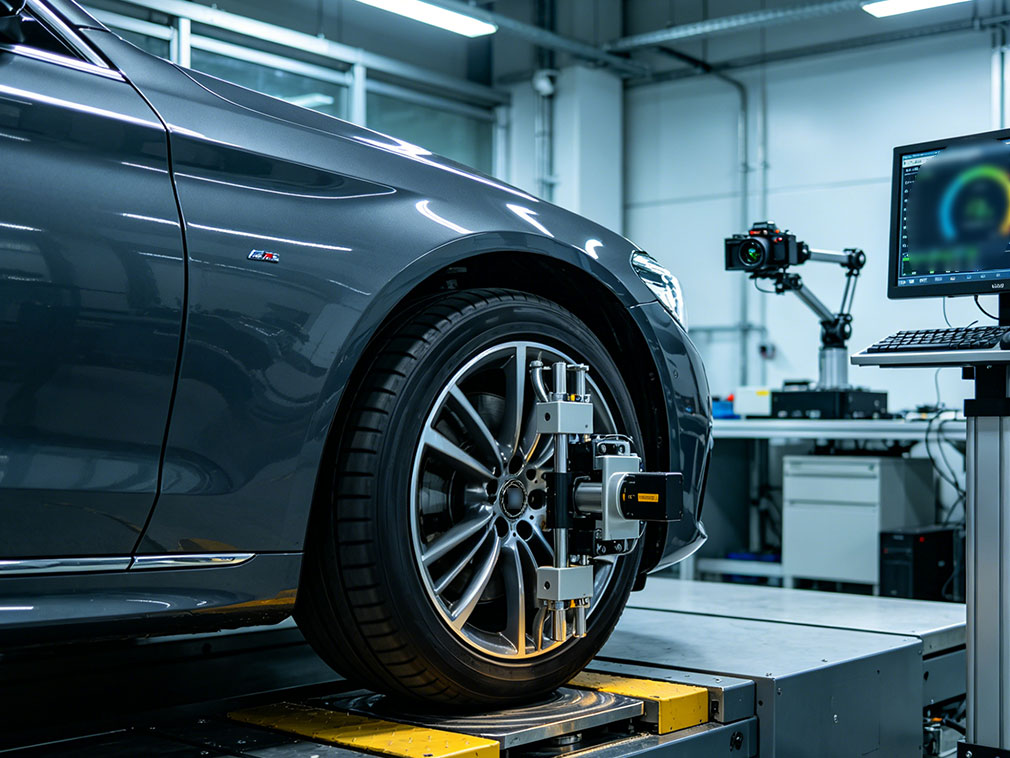
This type of testing can measure the longitudinal and lateral friction coefficients of tires under different operating conditions, serving the refined R&D and tuning of tire fundamental performance. During testing, parameters such as load, speed, road surface friction coefficient, and ambient temperature can be adjusted to individually examine the impact of single variables like rubber hardness, tread groove depth, and tire carcass structural stiffness on grip performance.
This allows for rapid identification of tire design shortcomings, providing data for early-stage compound optimization and structural adjustments, and is a core verification method in the tire development stage.
Whole vehicle road testing closely simulates real-world user scenarios and is a crucial step in confirming actual tire performance. Test results are more practical and valuable for reference. Standard test conditions cover typical scenarios such as dry emergency braking, multi-speed gradient wet braking, steady-state turning lateral grip, and complex road conditions, comprehensively covering daily commuting, rainy driving, and cornering.

The wet braking test, by strictly controlling the road surface water film thickness, simulates driving conditions under different rainfall intensities, verifying the tread pattern's drainage and anti-skid capabilities. The steady-state turning lateral grip test, conducted in a constant-radius corner, detects the tire's lateral adhesion limit and anti-skid capability, used to evaluate dynamic driving scenarios such as cornering handling and lane change avoidance.
In terms of performance quantification, longitudinal grip performance is primarily characterized by braking distances on dry and wet surfaces, as well as the coefficient of friction derived from the ratio of braking force to vertical load.
This directly reflects the tire's grip capability during straight-line driving and deceleration. Lateral grip performance, on the other hand, is comprehensively evaluated using indicators such as steady-state turning tests, lateral limit acceleration, and cornering limit speed, accurately reflecting the tire's lateral adhesion and handling stability during cornering.

Different testing methods have significantly different evaluation focuses: analytical tests emphasize the accuracy of basic performance, while vehicle road tests emphasize adaptability to real-world conditions. A single indicator cannot comprehensively define a tire's overall grip performance.
Therefore, in engineering evaluations, it is necessary to integrate laboratory data with real-world road test results, combining performance under different road and operating conditions for comprehensive judgment. This avoids evaluation bias caused by single data points, ensuring that tire performance fully meets the diverse travel needs of users.
-
Foreign Media Visits Yimin Open-Pit Mine: 100 Autonomous 90-Ton Trucks in Operation(Oct 9)8222
-
IRSG: Natural Rubber Prices Hit Multi-Year Highs, Short-Term Correction Pressure Expected(Oct 9)8615
-
Used Car Exports Enter a Trust-Based Phase: Over 450,000 Units in First 8 Months(Oct 9)5384
-
National Day Highway Charging Hits Record: +60.4% YoY(Oct 8)8283
-
New Energy Vehicle Exports Accelerate: 3.435 Million Units in First 8 Months, Up 120% Year-on-Year(Oct 8)8905




