Battery-Swap Heavy Trucks: From Policy Dividend to Market Test(Oct 22)
Battery-Swap Heavy Trucks: From Policy Dividend to Market Test
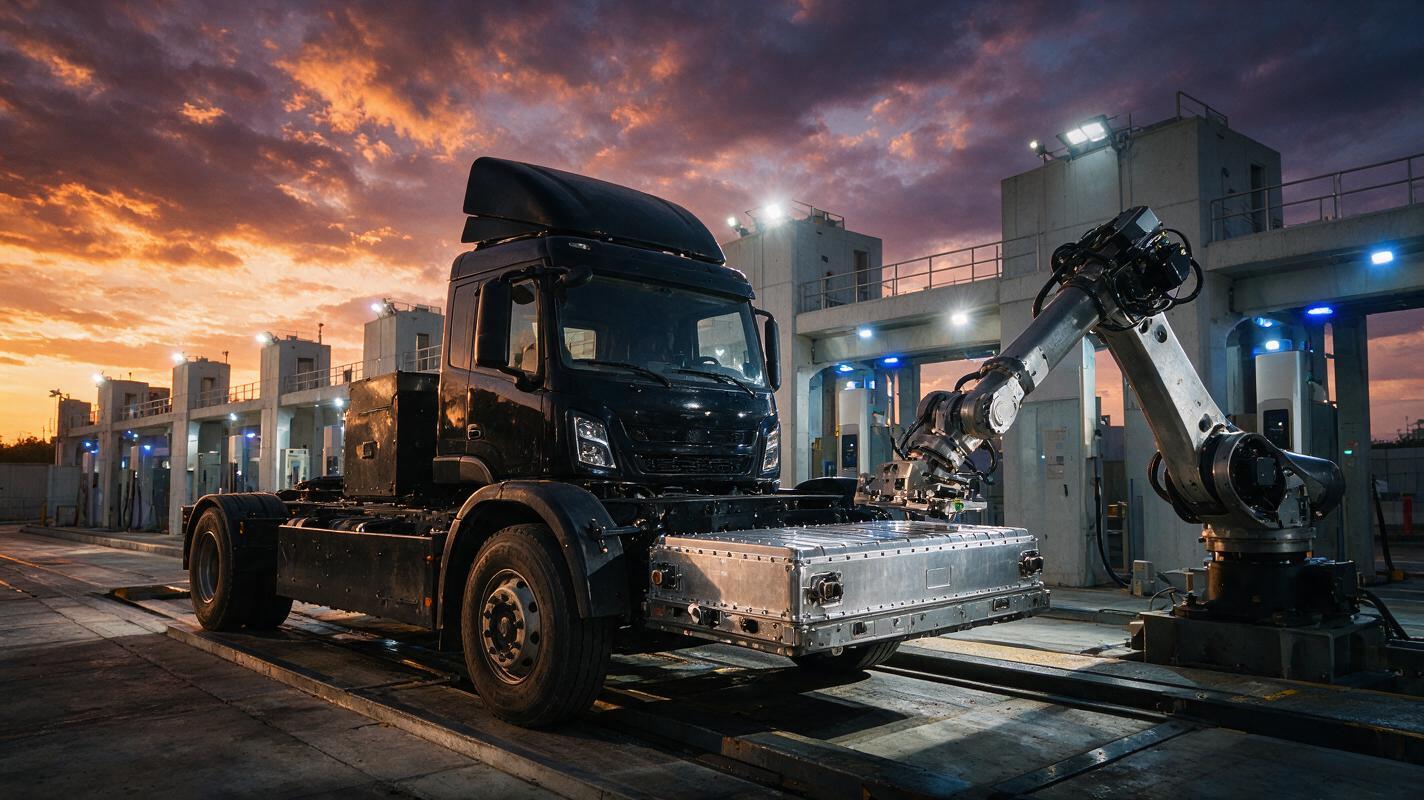
Source: China Automotive News / Dazhong Daily
In the first half of 2026, China sold 660,900 heavy trucks cumulatively, up 22.59% year-on-year. New energy heavy truck sales reached 140,000 units, up 80% year-on-year, with a penetration rate of 33.7%. Heavy truck electrification is accelerating from the trial phase toward market mainstream adoption.
However, a notable contrast has emerged: during the same period, battery-swap heavy truck sales were 34,000 units, up 36% year-on-year, clearly underperforming the broader market. From a market structure perspective, battery-swap models accounted for 30.39% of pure electric heavy trucks in 2025, but this share fell to 24.59% in the first half of 2026.
On one side, the overall market is expanding; on the other, market share is contracting. This reflects the reality of battery-swap heavy trucks: they have not been rejected by the market, but have moved from a policy-driven phase to a market-testing phase.
Industry experts note that charging heavy trucks have gained ground because they first captured the easiest scenarios: fixed routes, nighttime charging, and time-insensitive operations. The dilution of battery-swap truck share precisely shows the market is shifting from a single policy-driven path to scenario-differentiated multiple paths.
The three key operational challenges for battery-swap heavy trucks are: first, charging network density, as vehicles face a risk of losing network coverage outside core areas; second, standardization, as different manufacturers battery pack sizes, interfaces, and communication protocols remain incompatible, though national standards GB/T47961-2026 and GB/T47967-2026 were published in July 2026 and will take effect February 1, 2027; third, the profitability model under heavy-asset operations, where station profitability depends on daily vehicle turnover frequency.
Regarding technology routes, bottom-mounted battery swapping integrates the battery pack beneath the chassis, with a bottom robot completing assembly and disassembly. This approach does not require a gantry frame, has lower spatial requirements, lower center of gravity, and lower station construction costs compared to top-lift and side-draw alternatives.
This platform focuses on the import and export of Chinese automotive equipment, gathering hundreds of certified Chinese automotive suppliers and connecting with global buyers. The platform achieves full transaction transparency, expands diverse cooperation opportunities, and helps both domestic and foreign parties build deep and stable cooperation bonds. Whether you are looking for vehicle manufacturers, purchasing automotive parts, or need customized procurement solutions, CNAUTO is your trusted first choice for cooperation.
-
Battery-Swap Heavy Trucks: From Policy Dividend to Market Test(Oct 22)6321
-
Excavator Exports Surpass Domestic Sales for the First Time, Construction Machinery Industry Recovery Accelerates(Oct 21)8867
-
Chery Launches Industry's First V2G Large-Scale Operation Station(Oct 21)9748
-
60+ Tire Companies Raise Prices Collectively: Price Hikes Struggle to Keep Pace with Raw Material Surge(Oct 21)5305
-
Zijin Mining Science Conference: Self-Developed 230-Ton Pure Electric Mining Trucks Deployed at Scale(Oct 20)8597