
Race Tire Vs Daily Tire Selection
When watching top-level motorsport events like Formula One (F1), attentive viewers may notice an interesting phenomenon: in dry weather, the tires on racing cars have no grooves, presenting a completely smooth surface—what's commonly known in the industry as "slick tires."
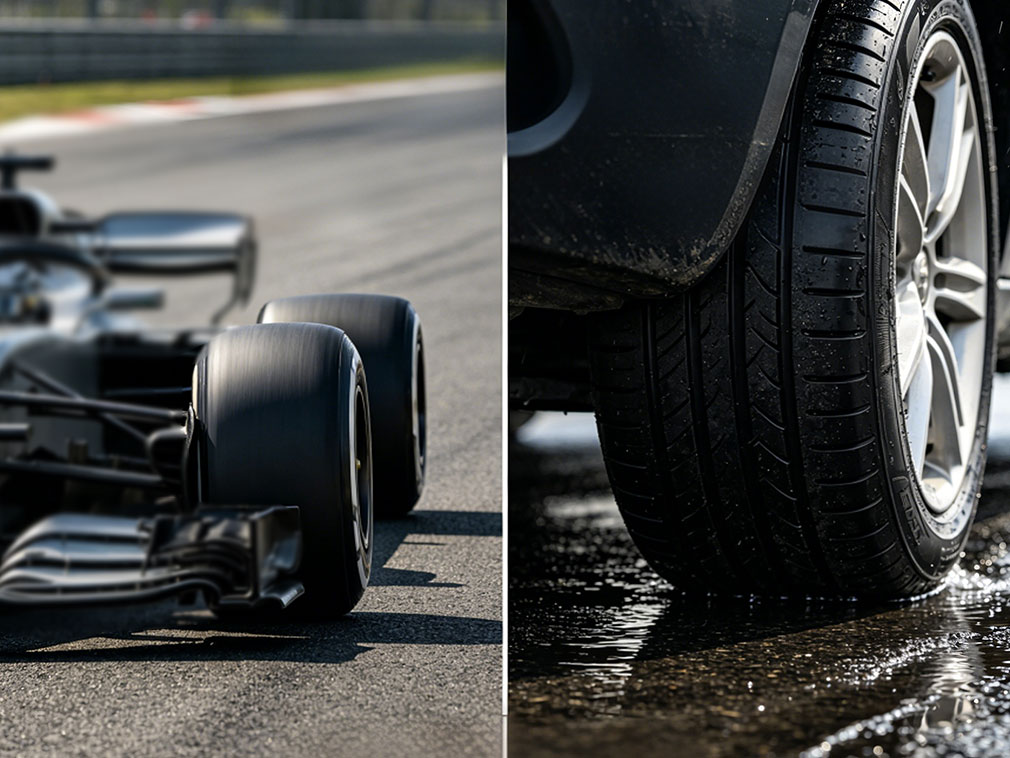
This contrasts sharply with the tires of everyday passenger cars, which are invariably covered with treads of varying depths. These two drastically different tire designs are not simply aesthetic choices, but rather the result of in-depth considerations based on physical principles, usage scenarios, and safety requirements.
To understand the advantages of slick tires, it's essential to understand the source of tire grip. The friction between the tire and the ground consists of two main components: sliding friction and adhesive friction. Rubber, as a viscoelastic material, microscopically penetrates into the cracks in the road surface when it comes into contact with a rough surface.
Because slick tires lack treads, their actual contact area with the ground reaches the maximum value for their size. A larger contact area results in stronger adhesive friction, and thus, a greater capacity for transmitting longitudinal driving force and lateral steering force.
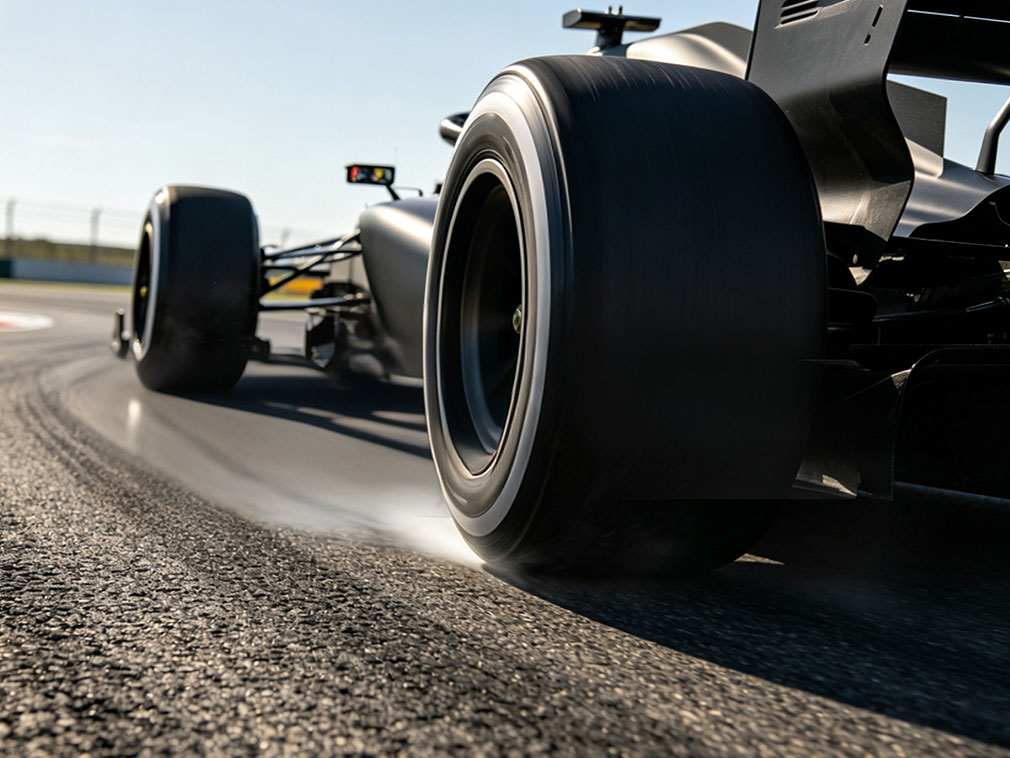
In Formula 1 racing, cars experience extremely high lateral G-forces in corners. Ordinary tires are prone to exceeding their grip limits and skidding under these extreme conditions. Slick tires, with their full contact patch, provide superior mechanical grip, allowing drivers to cut corners at higher speeds. Furthermore, since the 2022 season, F1 has fully adopted 18-inch wheels. Compared to the previous 13-inch wheels, the new slick tires have a structurally reduced deformation rate, resulting in more stable downforce performance in conjunction with the aerodynamic floor effect.
However, the "invincible" state of slick tires only exists on absolutely dry surfaces. Once wet, their weaknesses become apparent. When the road is wet, water enters between the tire and the road surface as the tire rolls. Since slick tires lack drainage channels, the water cannot be expelled quickly enough, causing the tire to be lifted off the ground by a film of water—a phenomenon known in physics as hydroplaning.
Once hydroplaning occurs, the tire completely loses grip, and the car skids out of control. This explains why our everyday vehicles must use treaded tires. Civilian vehicles need to cope with the complex environments of changing seasons and alternating sunshine and rain.
The core function of the tread grooves on the tire surface is drainage. When a vehicle is driving in the rain, the tread grooves act like miniature canals the moment the tire contacts the ground, squeezing out water accumulated in the contact area to the sides and rear, ensuring that the tire's rubber blocks can truly contact the road surface, thus maintaining basic grip.
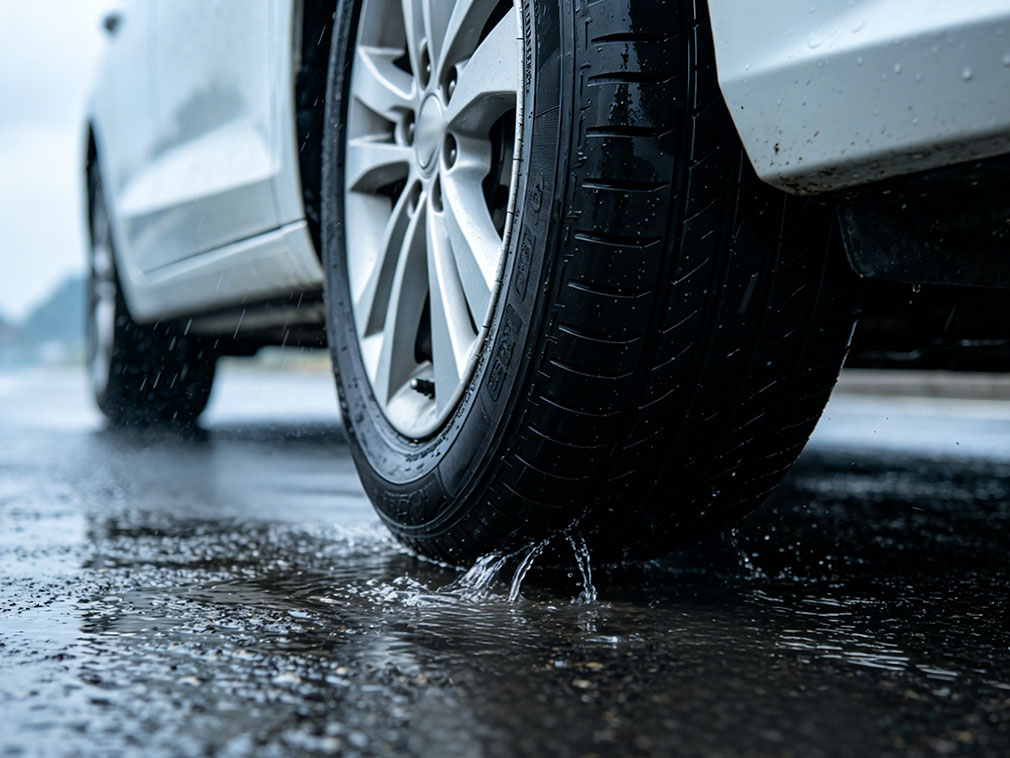
Besides drainage, the tread pattern of civilian tires also performs other important functions. For example, the edges of the tread can cut into water or mud on the road surface during vehicle start-up and braking, providing additional grip; at the same time, the arrangement and depth of the tread pattern also affect the tire's quietness and heat dissipation performance.
Depending on the emphasis, civilian tires are designed with unidirectional tread patterns that prioritize drainage, asymmetrical tread patterns that balance comfort and handling, and symmetrical tread patterns that adapt to various road conditions.
In fact, Formula 1 racing also follows this physical law. When rain occurs during a race, the organizers will issue a green or red flag, requiring teams to drive their cars into the pit lane and switch to rain tires with deep treads (full-weather or semi-weather tires).
For example, current F1 tire suppliers offer full-weather tires with deep grooves capable of absorbing tens of liters of water per second; while semi-weather tires have shallower grooves, suitable for wet or drying tracks. The FIA (Fédération Internationale de l'Automobile) regulations also explicitly stipulate that rain tires must have specific tread depths and arrangements to ensure race safety.
There is no absolute superiority between slick tires and treaded tires, they are specialized solutions developed by automotive engineering for different boundary conditions. Slick tires sacrifice all-weather capability to maximize dry grip, serving the pursuit of extreme speeds on the track, while everyday tire treads represent a compromise and adaptation to varying natural environments, trading some dry grip for a safety baseline in rainy conditions. This difference in design vividly reflects the automotive industry's pursuit of a balance between exploring the limits of physics and ensuring the safety of life.




