Nanjing Port's Green Liquid Ammonia Foreign Trade Channel Enters a New Phase of Regular Operation
On August 16, the Portuguese liquid cargo ship "Polaris" departed from the Qingjiang Terminal of Nanjing Port after loading 15,000 tons of liquid ammonia, heading to Ulsan, South Korea. As of now, the total export volume of liquid ammonia from Nanjing Port for foreign trade from June to August this year has reached 100,000 tons. Several benchmark vessels have continued safe operations, marking the official transition of Nanjing Port's green liquid ammonia foreign trade channel into a new phase of normalized operations.
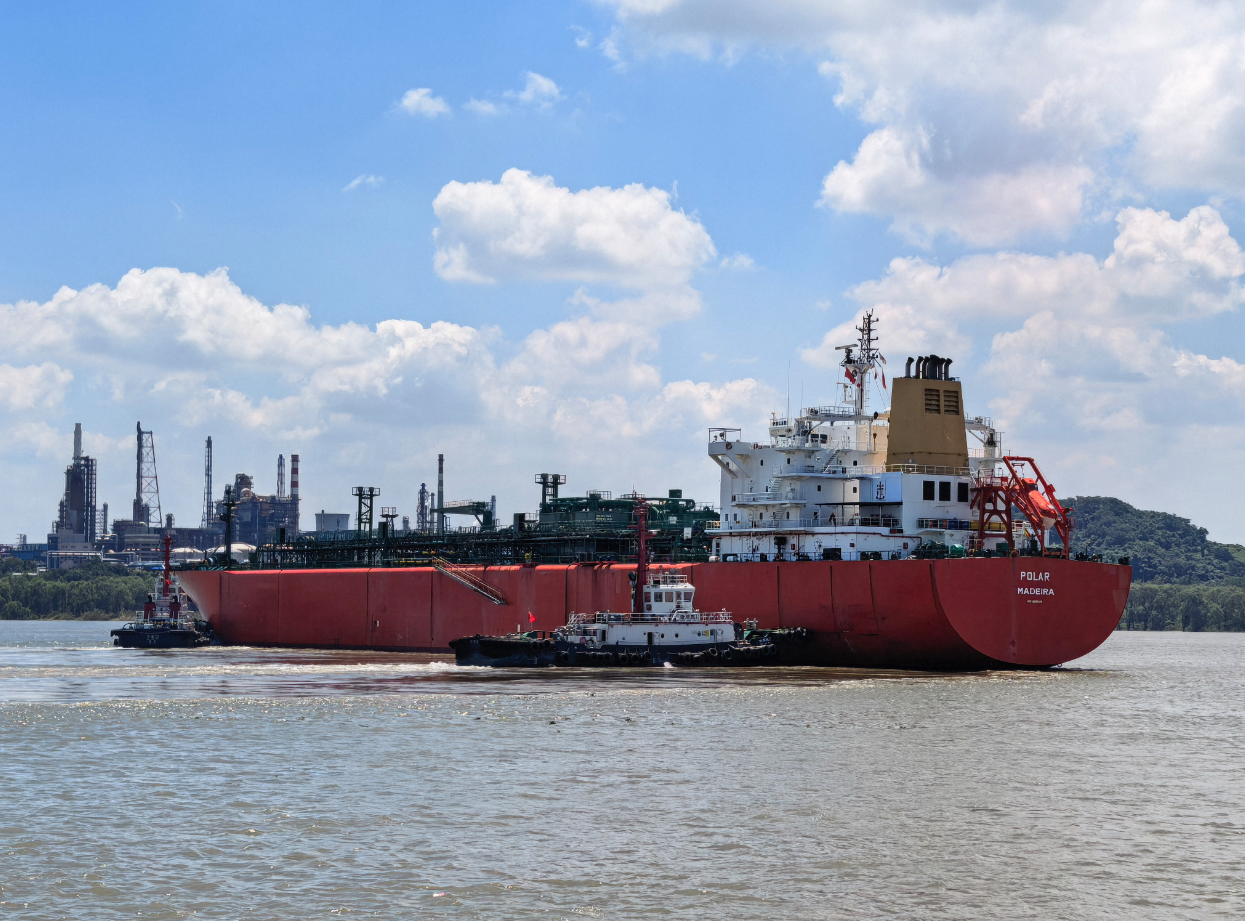
Since the beginning of this year, the layout of Nanjing Port's liquid ammonia foreign trade routes has been rapidly improved, with globally leading green vessels choosing Nanjing Port as their first loading port. Under the support of the Nanjing Maritime Safety Administration, the world's first ammonia-fueled ship "Antwerp" completed its maiden voyage and first loading at Nanjing Port on June 24, initiating a demonstration exploration of green liquid ammonia ocean transportation. On August 11, its sister ship "Arlon" loaded approximately 30,000 tons of liquid ammonia at Nanjing Port and sailed directly to India. The smooth clearance and departure of the "Polaris" further strengthened the liquid ammonia transportation routes from Nanjing to South Korea and other East Asian regions, steadily expanding the coverage and cargo capacity. Both the "Antwerp" and "Arlon" are among the world's first ammonia-fueled medium-sized gas carriers, equipped with ammonia fuel propulsion systems that significantly reduce carbon emissions compared to traditional fuel, setting a benchmark for the global shipping industry's green transition.
Liquid ammonia is a highly toxic and highly corrosive hazardous chemical. Combined with seasonal risks such as floods, typhoons, and high temperatures, the safety supervision of ship berthing and loading/unloading, as well as port coordination, faces significant pressure. The Nanjing Maritime Safety Administration, relying on the Jiangsu Maritime Administration (Nanjing) Hazardous Chemicals Ship Normalized Risk and Hazard Investigation and Governance Center, has coordinated efforts with customs, border inspection, terminals, and shipowners to establish a collaborative governance mechanism of "joint risk assessment, joint hazard management, and joint safety supervision," providing comprehensive safety assurance and efficient service support for liquid ammonia foreign trade exports.
In response to the characteristics of liquid ammonia vessels, such as large ship types, long operation cycles, and high control requirements, the Nanjing Maritime Safety Administration has implemented a "one ship, one policy" customized navigation guarantee, formulating special traffic organization plans in advance and precisely allocating waterway resources. It has deepened "streamlined and expedited review" government services, implemented a mechanism for accepting incomplete applications, reducing the processing time for single-ship procedures by 60%, and achieving "zero waiting" customs clearance for foreign trade goods. Relying on the normalized inspection mechanism of the collaborative governance center, law enforcement personnel conduct comprehensive safety inspections of berthed ships, verifying ship qualifications, liquid cargo tank inspection reports, and crew special operation qualifications item by item. They focus on inspecting the operational status of core equipment such as ammonia fuel supply, leak monitoring, and emergency inerting, addressing identified issues through a checklist-based closed-loop rectification process to strictly prevent ships from "operating with defects or berthing with risks."
During operations, the Nanjing Maritime Safety Administration utilizes a "maritime drone + intelligent CCTV" monitoring network, combined with a smart maritime platform for 24-hour online monitoring and on-site patrol boat presence, to ensure berthing and departure safety. It strengthens supervision and guidance on high-risk procedures such as pipeline connections and cargo transfers, safeguarding operational safety. Meanwhile, law enforcement personnel continuously conduct special education campaigns to prevent collisions between commercial and fishing vessels, check the implementation of ship safety training, inspect crew performance, distribute typical warning education materials, and urge ships to enhance watchkeeping, standardize communication channel usage, and reduce navigation safety risks along the coast.
Currently, Nanjing Port has established multiple liquid ammonia foreign trade ocean routes to South Korea, India, and other destinations. The proportion of green vessels carrying LNG, methanol, and other environmentally friendly fuels continues to increase. The service efficiency and brand influence of Nanjing's green energy shipping development are steadily improving. Moving forward, the Nanjing Maritime Safety Administration will continue to leverage the platform of the Hazardous Chemicals Ship Normalized Risk and Hazard Investigation and Governance Center, solidify the normalized regulatory service standards for ammonia-fueled ships, optimize the multi-department collaborative guarantee mechanism, and continuously enhance port safety supervision and comprehensive service levels, contributing to the green, low-carbon, and high-quality development of Nanjing's port and shipping industry.
-
Bohai Bay Port strives to become a benchmark for the transformation of small and medium-sized ports.4113
-
The 2026 Advanced Auditor Training Course for Crew Training Quality Management System Opens in Tianjin.4980
-
Maritime navigation and protection join forces to establish a "safety line" for fishing in the East China Sea.4640
-
The rotating duty of the light buoy in the Dalian sea area has been completed.3146
-
Chipolbrok's vessel "NOWOWIEJSKI" Set Sail Carrying the Second Shipment of TBM Equipment for Serbia's First Metro Construction Project4360